First — how modern GPS trackers actually work
Before you spend money on a sweep, understand what you’re actually up against. Every “professional” who can’t explain this stuff on demand is guessing.
1. They don’t broadcast constantly
A cost-effective always-on tracker dies in 4 hours. So every real GPS tracker sleeps 98% of the time. The unit wakes up on a schedule (every 5, 15, or 30 minutes depending on the mode), grabs a GPS fix from the satellite constellation (this takes 3–8 seconds), transmits the fix to the cellular network in a 1–3 second burst, then goes back to sleep. That’s the entire duty cycle. A person walking around your car with a “wand detector” during those 27 minutes of sleep sees nothing — and calls the vehicle “clean.” It isn’t.
2. They transmit on cellular bands, not Wi-Fi
Modern trackers use LTE Cat-M1 or NB-IoT — designed for low-power machine-to-machine devices. In Canada that’s mostly Rogers’ 700 MHz band and Bell’s 850 MHz. The cost-effective “spy detector” gadgets on Amazon look for 2.4 GHz Wi-Fi and 900 MHz analog audio bugs — the wrong bands entirely. Their LED won’t blink for the tracker on your undercarriage, even during a transmit burst.
3. Some transmit nothing at all
The next generation of tracking devices (“passive” trackers) don’t transmit until they’re physically pulled off the vehicle. They log GPS internally to flash storage, and the operator retrieves the SD card during service. No RF scanner on earth will find those. You need a non-linear junction detector — the ORION — to find the semiconductors regardless of transmission state.
4. Some don’t use GPS at all
Bluetooth trackers (AirTag, Tile, Chipolo) don’t need GPS or cellular. They piggyback off other people’s phones passing by. Detection requires a Bluetooth Low Energy sniffer walking the vehicle at close range, not an RF spectrum analyzer. Yes, we run this scan too — with Ubertooth One at layer 1 rather than a phone app that misses randomized MAC addresses.
What “everyone else” does — walking around with a wand
Watch a typical Counter-Surveillance Measures in the GTA. Someone shows up, opens the doors, and walks around the car for 20 minutes waving a $30 handheld gadget with a single LED. They can’t tell you what frequency they’re scanning. They can’t tell you the modulation format. They can’t produce a signal capture. When the LED blinks, they claim “clean” because it wasn’t in the car. When the LED doesn’t blink, they claim “clean” because there’s nothing there.
Neither answer is real detection. That’s guessing dressed up as service. And it’s the reason so many trackers found by our team were “already professionally swept.”
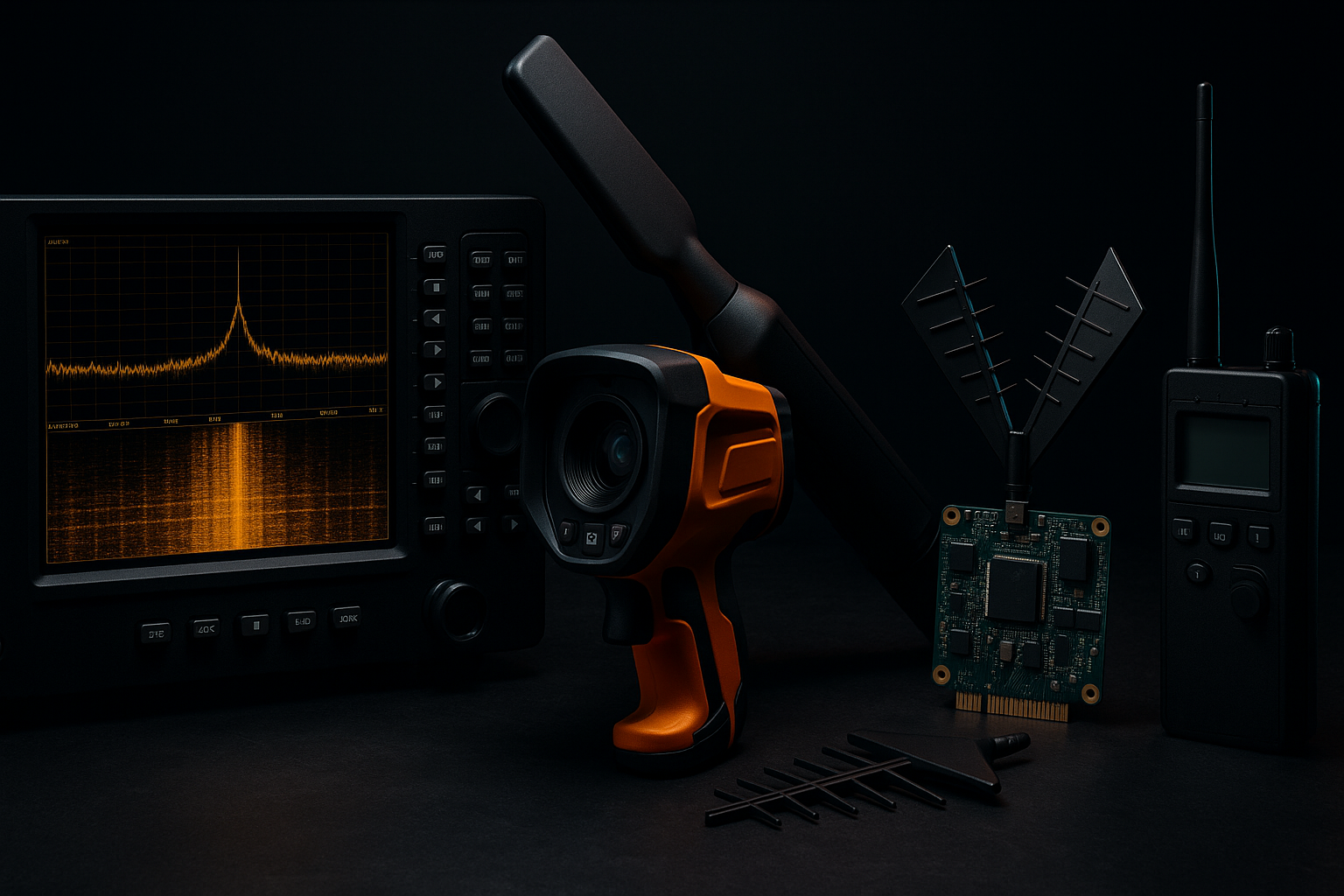
What real detection looks like — our arsenal
Tier 1 — Real-Time Spectrum Analysis
$34,000 CAD in-house
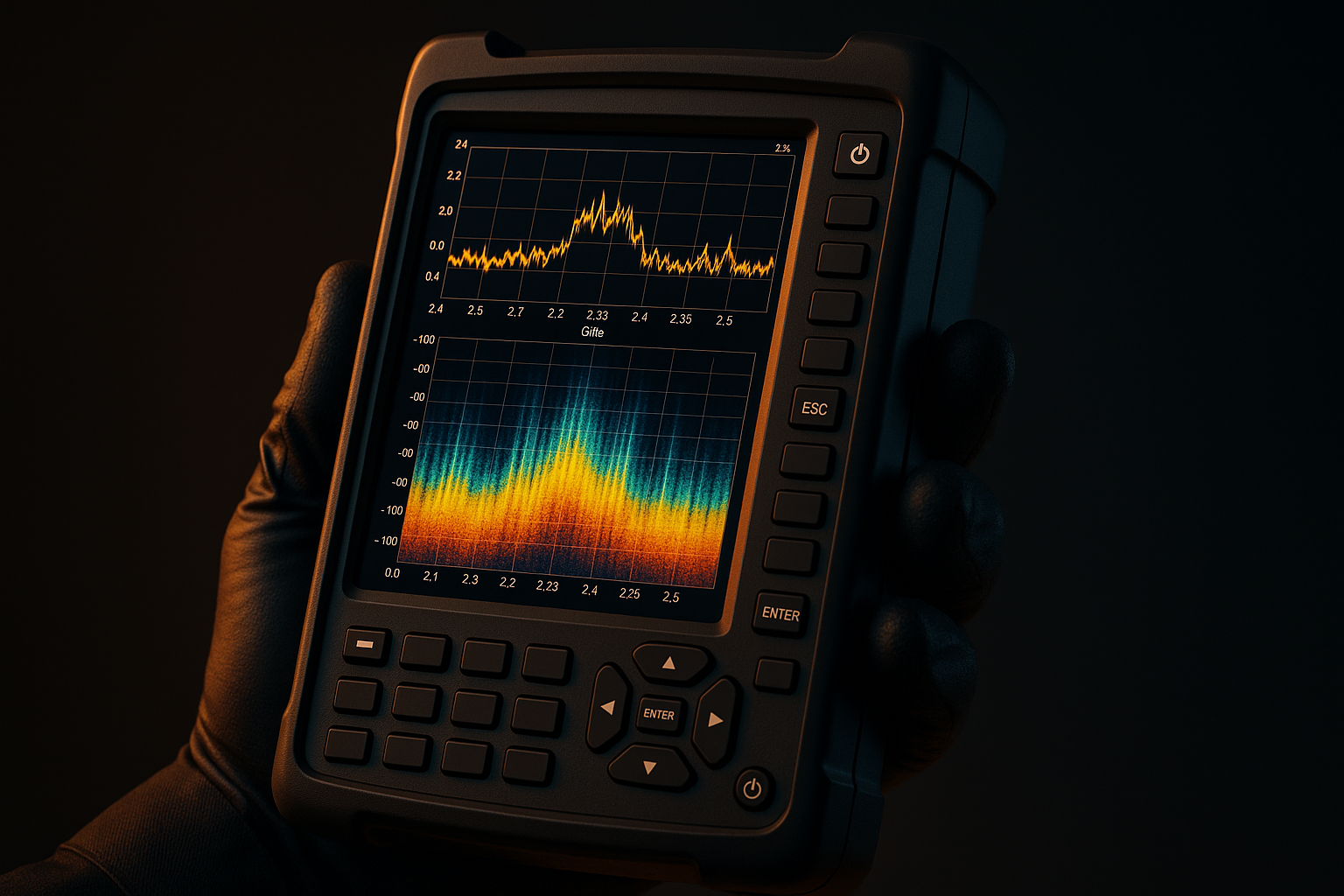
REI OSCOR Green — 10 kHz to 24 GHz
The industry standard used by DoD, FBI, and every court-certified TSCM operator in North America. 8 GHz real-time bandwidth. Catches every burst transmission — no missed bursts. $28,000–$32,000 CAD
Requires REI’s 5-day operator certification + 40+ hrs field practice.
Aaronia Spectran V6 RSA-3000X — 40 GHz portable
9 kHz to 40 GHz — future-proofed for 5G mmWave surveillance devices. German engineering, factory training required. $14,000–$18,000 CAD
Signal Hound BB60D — walk-around portable analyzer
9 kHz – 6 GHz backup unit running continuous while OSCOR performs targeted deep-dive. $4,800 CAD
Tier 2 — Non-Linear Junction Detection
$14,500 CAD
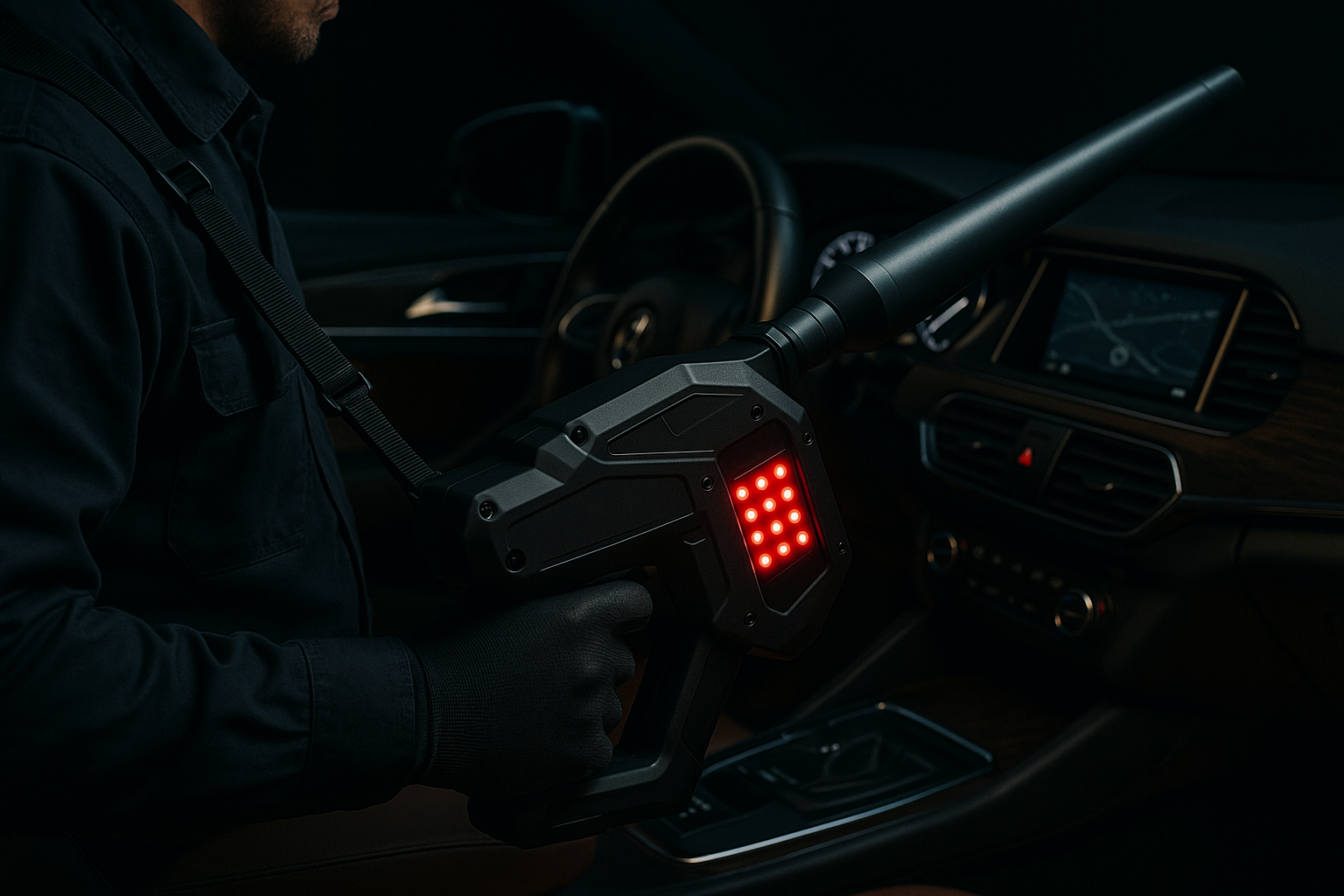
REI ORION 2.4 HX
Transmits 2.4 GHz microwave; listens for 2nd + 3rd harmonic returns from ANY semiconductor circuit — even when the device is powered off, battery removed, or wrapped in Faraday cloth. $14,500 CAD
The reason amateur NLJD operators produce garbage reports: real junctions vs. false junctions (rusted metal, corroded solder). We know the difference.
Tier 3 — Broadband + Handheld RF Detection
$12,000 CAD
REI ANDRE Advanced Handheld Broadband Receiver
RF, magnetic field, ultrasonic, infrared, VLF/AC audio-tap signatures — all in one unit. $9,500 CAD
Delta ROMEO 3 broadband receiver
Specialized for demodulating audio bugs (analog + digital). $2,500 CAD
Tier 4 — Software-Defined Radio
$3,400 CAD + hundreds of R&D hours
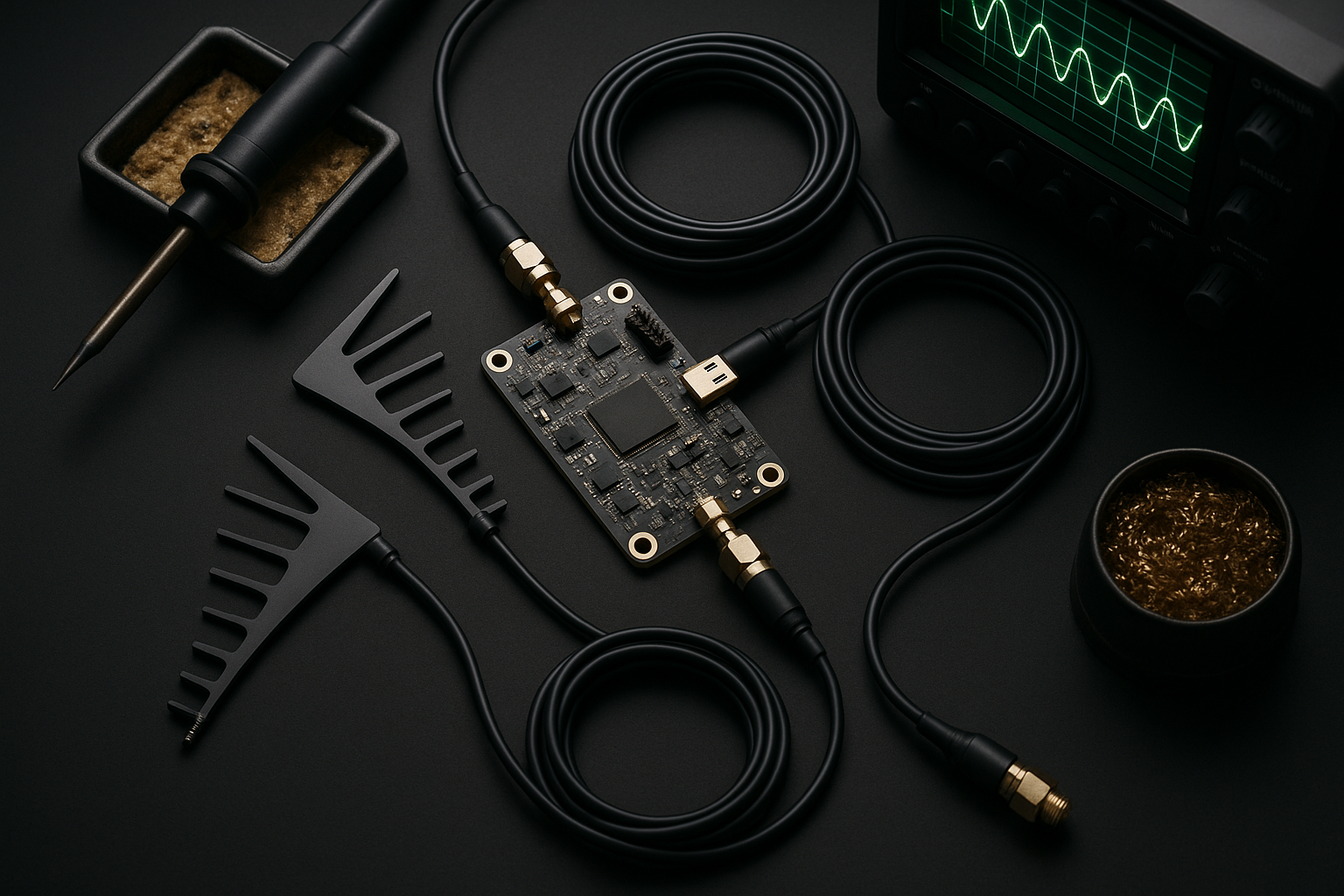
Ettus USRP B210 + directional log-periodic antennas
70 MHz – 6 GHz, 56 MHz real-time bandwidth. IQ capture + offline decode of GSM, LTE, LoRa, 802.15.4, custom ISM-band trackers. $3,400 CAD
Requires DSP fundamentals, GNURadio flow-graphs, and cellular protocol stacks 2G–5G — the reason SDR is a wall for non-engineers.
Tier 5 — Radiometric Thermal Imaging
$11,500 CAD
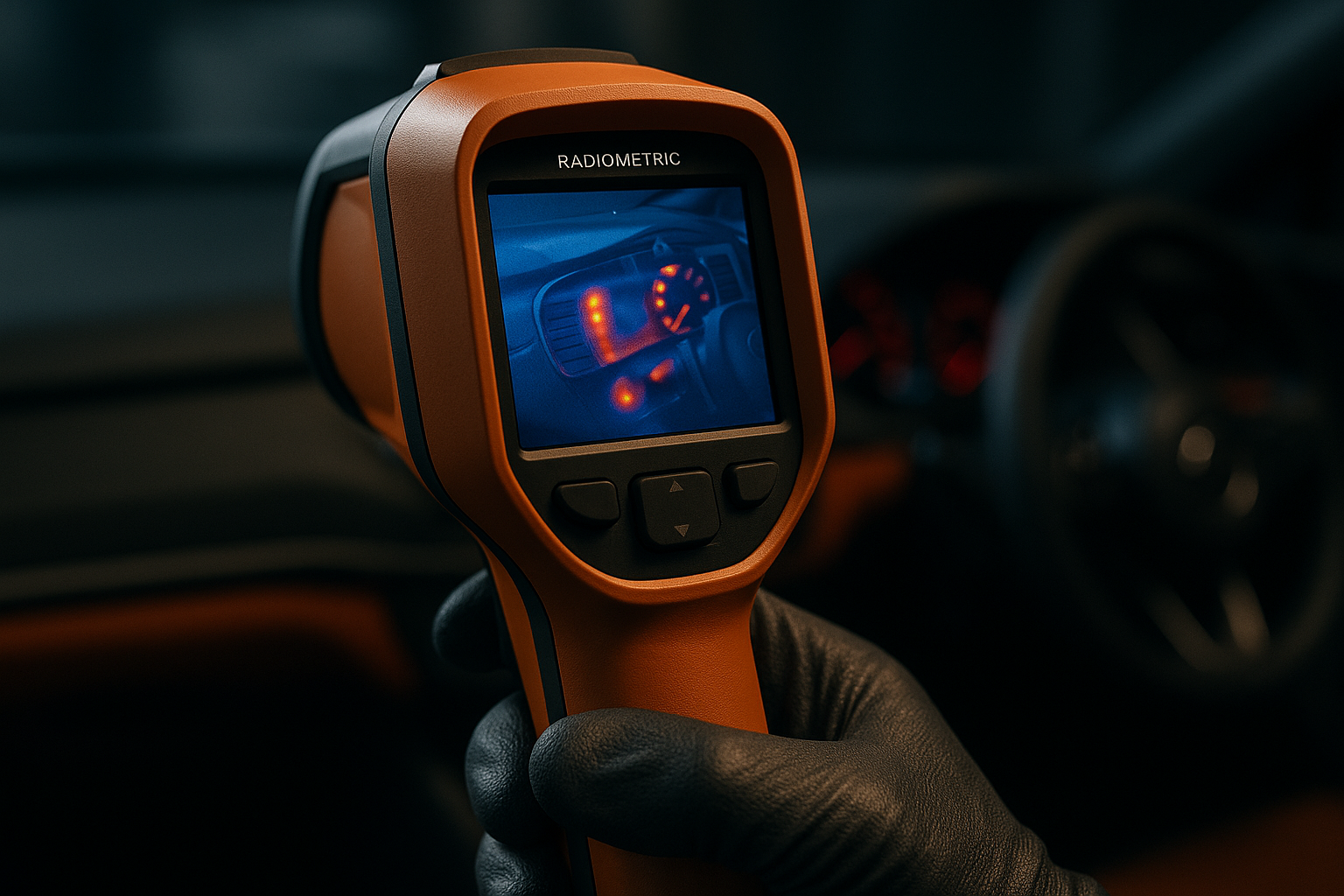
FLIR E86 — 464 × 348 radiometric camera
Thermal sensitivity 30 mK — an active cellular modem drawing 200 mW is unmistakable. Finds active electronics hidden under trim without disassembly. $11,500 CAD
Tier 6 — Cellular Baseband Monitoring
$7,200 CAD
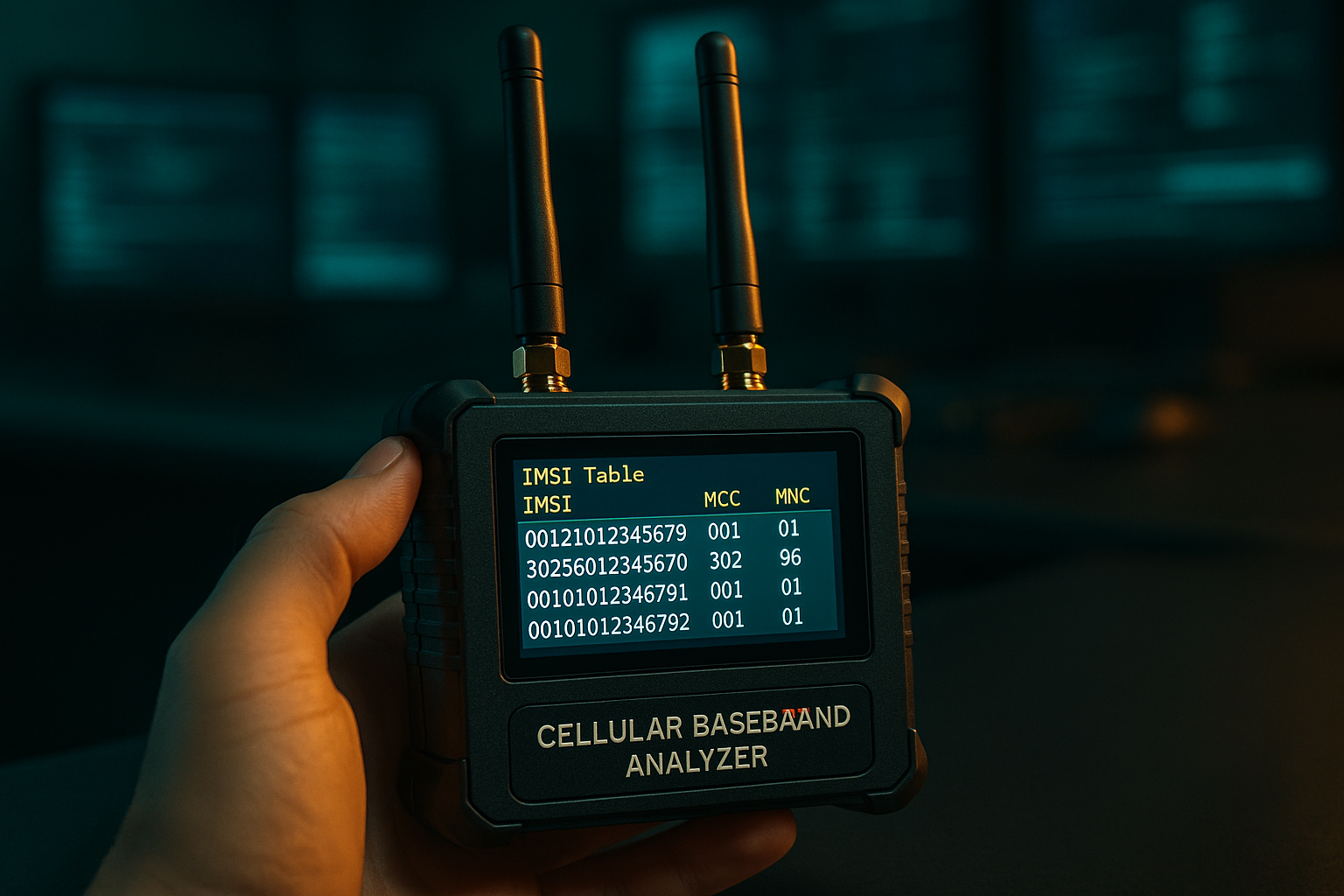
Delta-V AR-101 Cellular Analyzer
Passive monitoring of cellular control channels. Flags devices camping on nearby cell towers with non-standard IMSI or paging patterns. Identifies covert cellular modem trackers by their network attachment behaviour, even during silent periods. $7,200 CAD
Tier 7 — Chain of Custody
- Milwaukee wire tracer / magnetometer / current-probe kit — $1,500 CAD
- 2 mm + 5 mm articulating borescopes — $600 CAD
- Calibrated digital scale + macro photography rig — $400 CAD
- Numbered evidence bags, chain-of-custody logbook, notarized report software
Total arsenal value
| Tier | What it does | Retail (CAD) |
|---|---|---|
| 1 | Real-time spectrum (24 GHz + 40 GHz) | $34,000 |
| 2 | Non-linear junction detection | $14,500 |
| 3 | Broadband + handheld RF | $12,000 |
| 4 | SDR (with LNAs + antennas) | $3,400 |
| 5 | Radiometric thermal imaging | $11,500 |
| 6 | Cellular baseband monitoring | $7,200 |
| 7 | Support + chain of custody | $2,500 |
| Gear total | ~$85,100 | |
| + REI vendor certification (per operator, 3 modules) | ~$7,000 | |
| + Aaronia training (Germany) | ~$3,500 | |
| Total upfront to match this arsenal | ~$95,000 CAD |
What most “Counter-Surveillance Measures” operators actually use
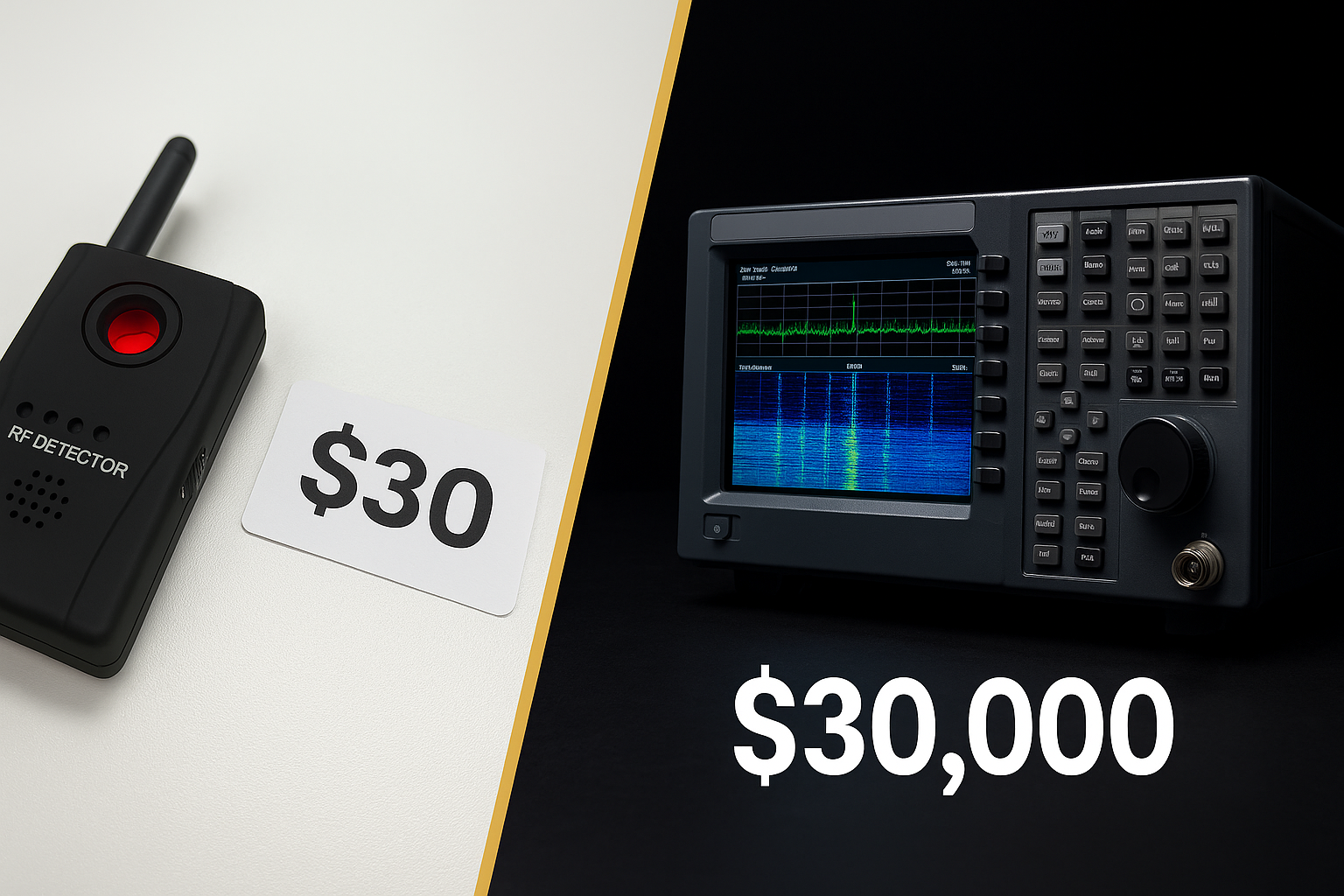
If you’re evaluating another provider, ask them to name their instruments. Here’s what you’ll usually hear back — and why none of it finds a professionally installed tracker.
Amazon “RF bug detector” — ~$25–$50
- Unbranded Chinese import. No FCC or Industry Canada certification.
- Single LED that lights up on ANY microwave-band RF — including your microwave oven, garage door opener, and the neighbour’s Wi-Fi router.
- No frequency display. No signal identification. No modulation decode.
- False positive rate at a typical Toronto address: 100%.
Pocket “spy detector” kits — $80–$200 (Amazon / eBay / AliExpress)
- Brands like “K18,” “Anti-Spy Pro,” “Zoweetek,” and dozens of unbranded clones — marketed at cheating spouse and hotel-room markets, not professional TSCM.
- Misses: burst-mode cellular trackers (dormant 99% of the time), sub-1 GHz LTE Cat-M1 / NB-IoT (where every modern GPS tracker lives), passive audio taps, powered-off semiconductor devices.
“Professional” handheld — KJB LM-8, Vindicator VDX-2000 — $300–$500
- Better than Amazon junk, but still single-band. No spectrum display. No waterfall. No signal capture. No calibration chain. Not accepted as evidence in Canadian courts.
The comparison, side by side
| Class | Gear cost | Cellular trackers | Powered-off devices | Court-admissible |
|---|---|---|---|---|
| Amazon RF detector | $30 | ❌ | ❌ | ❌ |
| Pocket spy detector kit | $100 | Partial | ❌ | ❌ |
| Camera lens finder | $30 | ❌ | ❌ | ❌ |
| “Pro” handheld (LM-8 class) | $500 | Partial | ❌ | ❌ |
| Fob Experts arsenal | $95,000 | ✅ | ✅ | ✅ |
Why the equipment gap is the whole game
A modern professional tracker doesn’t broadcast constantly. It sleeps for 29 of every 30 minutes, wakes up, transmits a GPS fix in a burst that lasts about 3 seconds on an LTE Cat-M1 band (~700 MHz uplink), then sleeps again. In that 3 seconds a phone-app scanner or a $30 Amazon RF detector shows nothing — because they scan too slowly, in the wrong band, without waterfall history.
Our REI OSCOR captures the entire spectrum, in real time, every 3 milliseconds, with a 24-hour waterfall memory. The burst has nowhere to hide. Our REI ORION NLJD finds the same tracker even if the battery is dead — because semiconductors reflect harmonics whether powered or not.
That is the difference between checking a box and finding what’s there.
Ready to book a real sweep?
Reserve a Vehicle Counter-Surveillance Measures →
Call (416) 676-9142 · Toronto + entire GTA · $99 deposit reserves your slot
Popular services by brand and city
Pick your vehicle make or service area for instant pricing and same-day service.